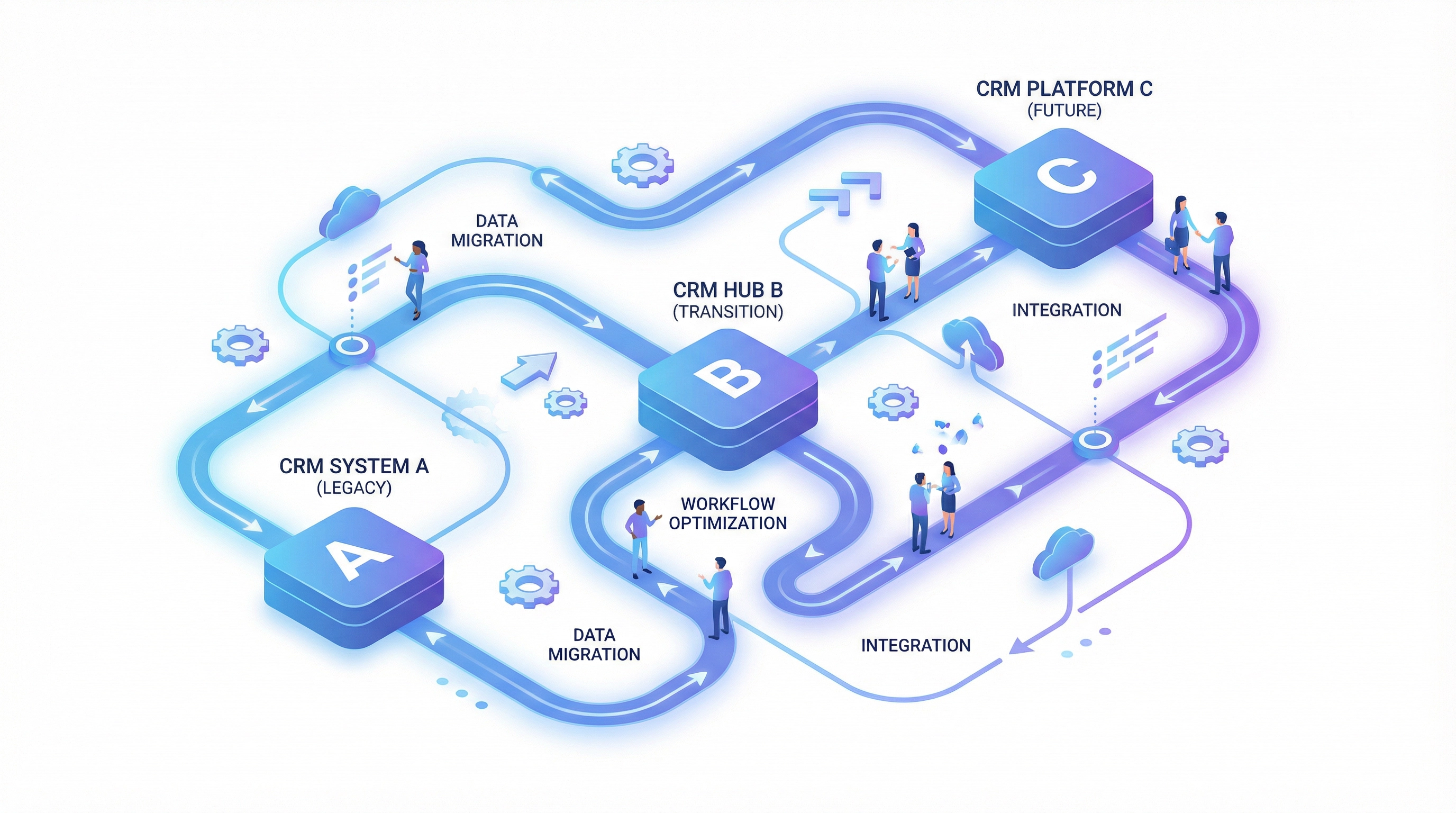
Teams would adopt a platform, invest time in setup and training, use it actively for six to twelve months, and then begin the search for something else. The pattern became predictable.
Three years ago, a client mentioned they were migrating from their CRM to something newer. Standard stuff. Happens all the time. What caught my attention wasn't the migration itself, but the reason: they'd switched to their current system eighteen months earlier. Two CRM changes in less than two years. That seemed excessive.
Then I started noticing the pattern everywhere. Teams would adopt a platform, invest time in setup and training, use it actively for six to twelve months, and then begin the search for something else. Not because of catastrophic failures. Just a slow accumulation of friction that eventually outweighed the switching costs.
The reasons varied, but they clustered around a few recurring themes. Integration issues that seemed minor during setup became daily annoyances. Features that looked essential during the sales demo turned out to be rarely used. Workflows that made sense in theory created bottlenecks in practice. And most commonly: the system worked fine for the initial use case but couldn't adapt when the team's needs evolved.
What's interesting is how predictable the cycle became. The first few months were characterized by optimism and active adoption. People would customize dashboards, set up automations, and generally try to make the system work. Then came a plateau phase where usage stabilized but enthusiasm waned. Finally, someone would mention trying a different tool, and within weeks the conversation would shift from "how do we make this better" to "what should we switch to."
I watched one team go through this cycle three times. Each migration was supposed to be the final one. Each new system promised to solve the problems of the previous one. And each time, within a year, the same frustrations resurfaced. Not identical frustrations—different systems create different problems—but the underlying pattern remained consistent.
The financial cost of these switches is obvious. Subscription fees, migration expenses, training time, temporary productivity loss. But the less visible cost is the erosion of trust in the category itself. After the third switch, teams stop believing that any CRM will actually solve their problems. They start viewing these tools as necessary evils rather than productivity enhancers.
Part of the problem is that CRM systems are sold on the promise of organization and efficiency, but they're implemented into environments that are already chaotic. The tool can't fix underlying process issues. It can only make existing processes more visible, which sometimes makes the dysfunction more apparent rather than less.
I've seen teams blame the software when the real issue was unclear ownership of customer data. Or inadequate onboarding processes. Or misaligned incentives between sales and support. The CRM becomes a scapegoat for problems that existed before it was implemented and will persist after it's replaced.
There's also a timing issue. Teams usually start looking for a new CRM when they're experiencing pain with their current setup. That pain creates urgency, which leads to faster decision-making and less thorough evaluation. They're not choosing the best tool for their needs; they're choosing the tool that seems most different from what's currently frustrating them. Which means they're optimizing for contrast rather than fit.
This explains why teams often cycle between different types of systems. They'll move from a complex enterprise platform to a simpler, more streamlined tool. Then, when they hit the limitations of simplicity, they'll swing back toward something more robust. Neither approach is wrong, but the pendulum swing suggests they're reacting to immediate pain rather than thinking through long-term requirements.
The teams that break this cycle tend to share a few characteristics. They're more honest about their own limitations. They acknowledge that the tool won't fix process problems. They invest time in proper setup and training, even when it feels tedious. And they resist the temptation to customize everything immediately, preferring to learn the system's intended workflow before modifying it.
They also tend to have clearer definitions of success. Instead of vague goals like "better organization" or "improved efficiency," they identify specific metrics: response time, conversion rate, data accuracy. This makes it easier to evaluate whether the system is actually working, rather than relying on subjective feelings of satisfaction or frustration.
But even with these practices, switching still happens. Sometimes the tool genuinely isn't the right fit. Market needs change. Teams grow. New integrations become essential. The difference is that these switches are strategic rather than reactive. They're planned migrations based on clear criteria, not desperate escapes from accumulated frustration.
I've also noticed that the teams most satisfied with their CRM tend to be the ones using it in fairly standard ways. They're not pushing the boundaries of what the system can do. They're not building complex custom workflows. They're using the core features as intended, and those features align well with their needs. There's something to be said for boring, predictable functionality.
The tools themselves have gotten better over the years. More intuitive interfaces, better integration options, more flexible pricing. But the fundamental challenge remains: CRM systems require sustained organizational discipline to be effective. They don't create discipline; they depend on it. And discipline is hard to maintain, especially when the team is growing or the business is changing rapidly.
For teams currently evaluating options, the most useful question isn't "which CRM is best?" It's "what specific problems are we trying to solve, and how will we know if they're solved?" Without clear answers to that, you're just setting yourself up for another migration in eighteen months.
There's also value in talking to teams who've been using a system for more than two years. Not the success stories featured in case studies, but regular teams who've worked through the initial excitement and the subsequent disillusionment and found a stable equilibrium. They'll tell you what actually matters versus what sounds impressive in demos.
The pattern I've observed over these three years isn't that CRM systems are bad or that teams are making poor choices. It's that the gap between how these tools are marketed and how they're actually used creates unrealistic expectations. The marketing emphasizes transformation and efficiency gains. The reality is more about incremental improvement and ongoing maintenance.
Understanding that gap makes it easier to evaluate tools realistically. You're not looking for a system that will revolutionize your workflow. You're looking for one that will handle your daily tasks reliably without creating new problems. That's a much more achievable standard, and it's the one that tends to result in longer-term satisfaction.
For teams considering [CRM platforms like Pipedrive](https://www.pipedrive.com){rel="sponsored"}, the key isn't finding the most feature-rich option or the one with the slickest interface. It's finding the system that aligns with how your team actually works, not how you wish you worked. That requires a level of self-awareness that's uncomfortable but necessary.
The cycle of switching will probably continue. New tools will emerge, promising to solve the problems of their predecessors. Teams will migrate, hoping this time will be different. Some will find what they need. Others will end up back in the same pattern. The difference will come down to whether they're choosing based on clear criteria or just reacting to current frustrations.
What I've learned from watching this pattern repeat is that the tool matters less than the process of choosing and implementing it. A mediocre system used consistently will outperform an excellent system used sporadically. And consistency requires buy-in, which requires understanding what you're actually trying to accomplish. Without that foundation, even the best CRM won't prevent the next migration.
The teams that recognize this early—that acknowledge the switching cycle and work to break it—tend to have more stable tool stacks and less organizational churn. They're not immune to needing changes, but those changes are deliberate rather than desperate. And that makes all the difference in whether the migration actually solves problems or just postpones them.