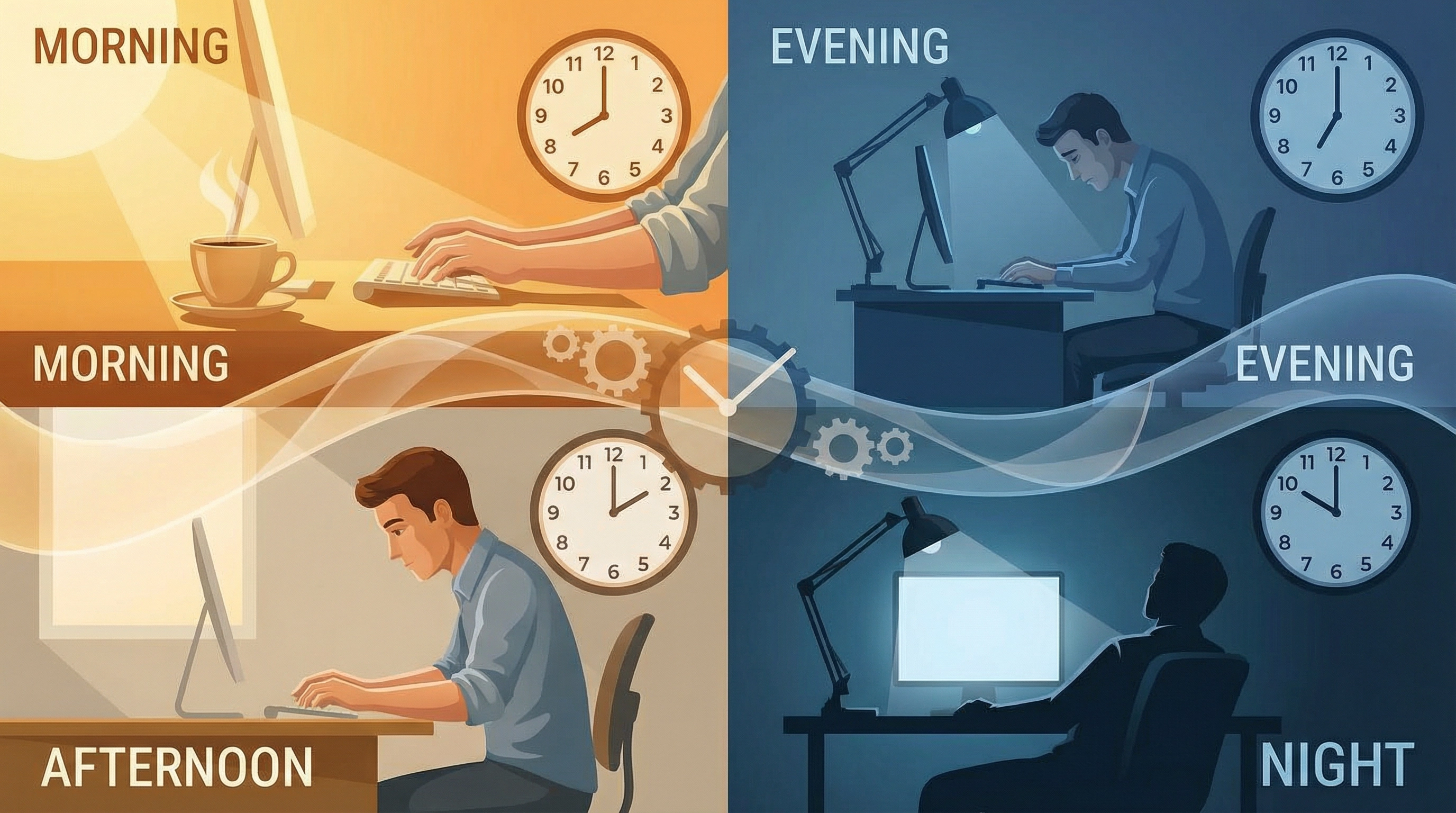
At nine in the morning, with coffee and a clear head, a task takes twenty minutes. At nine in the evening, after a full day, the same task stretches to forty-five minutes. Same task. Same tools. Completely different experience.
There's a task I do regularly that requires pulling data from three different sources, cross-referencing them, and generating a summary. At nine in the morning, with coffee and a clear head, it takes about twenty minutes. At nine in the evening, after a full day of meetings and decisions, the same task can stretch to forty-five minutes or more. Same task. Same tools. Completely different experience.
The tools haven't changed. My familiarity with them hasn't changed. What's changed is my cognitive state, and that state dramatically affects how I interact with software. In the morning, I can hold multiple pieces of information in working memory simultaneously. I can switch between tabs without losing track of what I was doing. I can spot patterns quickly. By evening, all of that becomes harder. I have to write things down. I lose my place. I miss obvious connections.
This matters more than I initially realized. When evaluating tools, we tend to test them during our peak cognitive hours. We're fresh, focused, and able to navigate complexity without much friction. But a significant portion of actual use happens outside those peak hours. Late afternoon when energy is flagging. Evening when you're trying to finish something before logging off. Early morning before you're fully alert. The tool that works smoothly at peak performance might create significant friction at other times.
I've noticed this pattern with different types of tools. Project management systems that feel intuitive in the morning can become mazes of nested menus by evening. Communication platforms that facilitate quick decisions during the day require more effort to parse when you're tired. Even simple tools like email clients demand more cognitive load when your mental resources are depleted.
The difference isn't just about speed. It's about the type of thinking required. Some tools demand active problem-solving—you have to figure out how to accomplish what you want. Others provide clear paths that require minimal decision-making. The former works fine when you're sharp. The latter becomes essential when you're not.
This creates an interesting evaluation challenge. If you only test a tool during your best hours, you're missing a significant part of the usage experience. You need to test it when you're distracted, tired, or mentally overloaded. Because that's when the design choices really matter. That's when the difference between three clicks and five clicks becomes meaningful. That's when clear labeling versus clever labeling determines whether you can complete the task or give up in frustration.
I've started deliberately testing tools during off-peak hours. Not exclusively—morning testing is still valuable—but as a supplement. I'll try to complete a task at the end of a long day and pay attention to where I struggle. If I'm making mistakes or getting confused, that's signal. It means the tool requires more cognitive resources than I have available at that moment. And if I don't have those resources available regularly, the tool might not be as suitable as it seemed during the initial evaluation.
The tools that work well across different mental states tend to have certain characteristics. They minimize the number of decisions required. They provide clear feedback about what's happening. They make it easy to recover from mistakes. They don't rely heavily on remembering information from one screen to the next. These aren't the features that get highlighted in marketing materials, but they're the ones that determine whether a tool remains usable when you're not at your best.
There's also a rhythm component. Some tasks naturally fit certain times of day. Creative work often flows better in the morning. Administrative tasks might be easier to batch in the afternoon. Communication-heavy work might align with when your team is most active. Tools that align with these natural rhythms feel easier to use, not because they're objectively better, but because they match the cognitive demands of the task with the cognitive resources available at that time.
This is particularly relevant for [remote teams](/use-cases/remote-teams) working across time zones. The tool that works perfectly for someone in their morning might be frustrating for someone else using it in their evening. Asynchronous workflows become more important not just for coordination, but for cognitive load management. If the tool requires real-time interaction and quick decision-making, it's going to be harder to use effectively when team members are in different mental states.
I've also noticed that the same problem can feel urgent or manageable depending on when it occurs. A technical issue that crops up at ten in the morning feels solvable. The same issue at six in the evening feels overwhelming. The objective difficulty hasn't changed, but my perception of it has. And that perception affects how I interact with the tools meant to solve it. I'm more likely to try workarounds, more likely to make mistakes, more likely to defer the problem rather than addressing it immediately.
This has implications for how we design workflows. If a task consistently needs to happen during low-energy hours, it might be worth investing more time in automation or simplification. Not because the task is inherently difficult, but because the timing makes it harder than it needs to be. The tool might be fine; the scheduling might be the problem.
It also suggests that flexibility matters more than we often acknowledge. A tool that can be used in multiple ways—quick and dirty when you're rushed, thorough and careful when you have time—is more valuable than one that only supports a single approach. Because your needs change throughout the day, and rigid tools don't adapt to that variation.
The morning version of me and the evening version of me have different capabilities. The morning version can handle complexity, ambiguity, and multi-step processes. The evening version needs simplicity, clarity, and minimal friction. The tools I rely on most are the ones that work for both versions. They don't require me to be at my best to use them effectively.
This isn't about the tools being "easy" in the sense of lacking depth or capability. It's about them being considerate of cognitive load. They don't make me work harder than necessary to accomplish what I need. They reduce friction where it doesn't add value. They save my mental energy for the parts of the task that actually require thinking.
When I look at [comparison frameworks](/comparisons) now, I pay attention to how tools handle routine tasks. Not the impressive features or the complex capabilities, but the boring, repetitive actions that happen multiple times a day. Because those are the ones that will happen at nine in the evening when I'm tired. And if the tool makes those actions harder than they need to be, it doesn't matter how powerful it is during peak hours.
The same problem feeling different at different times isn't a personal failing or a sign that I need better time management. It's a recognition that cognitive resources fluctuate, and tools should account for that fluctuation. The best tools don't just work when you're at your best. They work when you're not. And that's a much harder standard to meet, but it's the one that actually matters for sustained use.
I've stopped evaluating tools solely based on their capabilities and started evaluating them based on their demands. What do they require from me? How much attention, how much memory, how much decision-making? And does that match what I have available not just in ideal conditions, but across the full range of conditions in which I'll actually use them?
The answer to that question determines whether a tool becomes part of my regular workflow or something I only use when I have the energy to deal with it. And tools that only get used in ideal conditions don't get used much at all.